Monday, May 28, 2012

The Macedonian can be called neither Bulgarian nor Serb, but simply Macedonian

I said that I would rather call your Bulgarophones Macedonians. You call those people
Bulgarophones, owing to their language which is similar to Bulgarian. But, is it Bulgarian,
is it the same language spoken in Sofia? No. Macedonian is just as similar to Serbian as it
is to Bulgarian. I am not a linguist and I would not allow myself a personal judgment, but
disinterested Balkanologists have asserted to me that Macedonian is more similar to
Serbian than Bulgarian. It is possible that there are linguists who assert the opposite. But it
is a fact that the Macedonian language is spoken neither in Sofia nor in Belgrade. It is an
individual Slav language, just as we have the Romansch in Switzerland, spoken in Grisons,
apart from Italian. To my mind, the Macedonian can be called neither Bulgarian nor Serb,
but simply Macedonian.
taken from this book, R. A. Reiss, Sur la situation des Macedoniens et des musulmans dans les nouvelles
provinces grecques. Paris, 1918, pp. 6-7.

A picture of Voden (Edessa) in Macedonia from 1916-1918

Here is a picture of Voden the town was not renamed to Edessa at this time, 1916-1918. The town was renamed in the 1930s by the Greek Government.


Rene Picard: The Autonomy of Macedonia, 1916

July 20, 1916
Rene Picard: The Autonomy of Macedonia
The idea of Macedonian autonomy is familiar to all those who are acquainted with Balkan
history and politics. If we asked the Christians of Macedonia they would answer that
autonomy was the most desirable solution for them.
There is and, in fact, there has always been a Macedonian spirit in Macedonia.
Geographically, Macedonia has its own unity. Its borders are the following: to the south -
Mt Olympus, the mountains on the north bank of the River.. Bistrica, Lake Prespa and
Lake Ohrid; to the west -the Drim from Debar; to the north-west and north -the Sar
Mountains, the highlands north of Skopje, the defile of Kumanovo, the mountains that
mark the Serbo-Bulgarian frontier of before 1912; to the east -the Rhodope Mountains.
The borderline with Thrace on this side is not clear. The regions of Drama and Kavalla can either be adjoined to Macedonia or separated from it; the plain of Drama is populated
mostly by Turks; the town of Kavalla, like all the ports, has a strong Greek colony. To the
south, the Chalcidice Peninsula is geographically Macedonian, but ethnographically
Greek; the line of lakes separates it by a natural border from the rest of Macedonia.
Within these borders Macedonia has the natural basins of Skopje, Bitola, Veles, Serez,
Drama and Salonika with the mountains that separate them and the narrow valleys that
unite them. The Christian population in the country side is Slav. It is known to be neither
quite Bulgarian, although it is closer to the Bulgarians, nor quite Serbian. The Bulgarians
themselves admit that the Macedonians differ from the other Bulgarians: they possess a
more lively spirit, are more fond of politics and intrigue, more inclined to eloquence and
the arts, also more cunning; in a word, they are a little Hellenized. The Macedonian
politicians in Sofia are feared; many Bulgarians of old Bulgaria would be glad to see the
Macedonian Bulgarians return to Macedonia. They accuse them of taking everything away
from them, their jobs and privileges. Many Balkan people think that there will be no
stability in the Balkans until Macedonian autonomy comes into existence. In any case, it is likely that the creation of Macedonian autonomy would quickly develop a Macedonian
spirit and patriotism.
The autonomy of Macedonia and the constitution of a Balkan federation would have most
ardent advocates among the citizens of Salonika, especially among the majority of the
Jewish population. The annexation to Greece caused their ruin. Salonika was a particularly important port from, which the Austro-German products brought from Triest were distributed all over the peninsula; the new border, having separated Salonika from its background, delivered a terrible blow to it. The Greeks, who already have other ports, are not able to support Salonika. The geographical position of Salonika at the debouchement of the great natural route from the Danube to the Aegean Sea via Nish has always made this port to be of primary economic importance, and this economic importance will ensure it an equivalent degree of political importance. One can be certain that either there will never be a Balkan federation, or Salonika will be its port as well a sits intellectual and economic centre. One can very well see Salonika in the future as a free city, the capital of autonomous Macedonia and the centre of the Balkan federation.
To hold such an important point, although provisionally and awaiting the settlement of all the Balkan questions and the strengthening of the new status of the peninsula, would be of considerable advantage for the allies. They would have a means of pressure upon their friends of all degrees, as well as upon their enemies. We shall have many friends after our victory, and at that moment we shall have to take precautions against them.
What will become of Macedonia? This is the whole problem of the Balkans.
Taken from Les archives du Ministere des affiars etrangeres (Paris). Guerre 1914-1918, Balkans, Dossier generale, pages 158-165.

The German Linguist Albrecht Wirth recognized the Macedonians in 1914


“Ursprünglich gibt es zwei große Zweige der Südslawen: Serben und Slowenen; dann könnte allenfalls die Mazedonier als eigener Stamm gelten. Durch Mischung der Slowenen mit einem anarischen/awarischen Volk entstanden die Bulgaren.”


[English]
Originally there are two big branches of the south Slavic people, Serbians and Slovenians, then if necessary the Macedonians could be seen as a further branch . Through a mix between the Slovenians and an Avaric tribe, the Bulgarians were created.


 “Die Bulgaren können im Königreich mit 3,2 Millionen angenommen werden, zusammen mit den Mazedonier 4 Millionen.”

[English]
The Bulgarians in the Kingdom are about 3.2 million people, together with the Macedonians 4 million people.


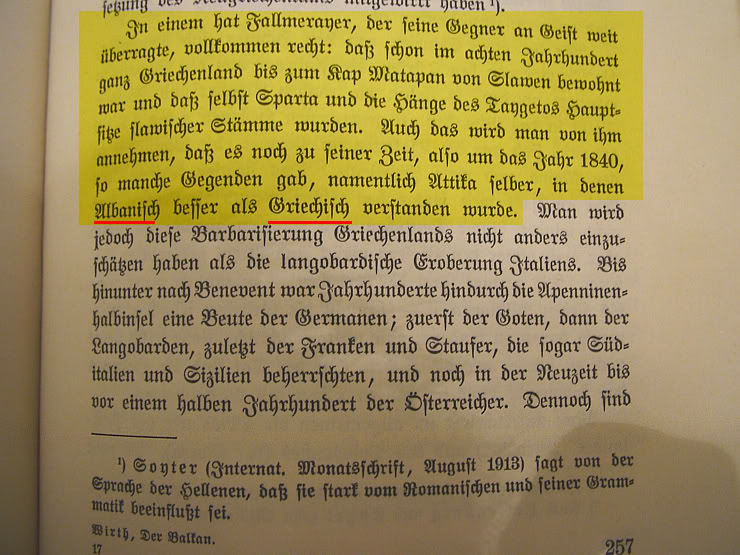
 “In einem hat Fallmerayer, der seine Gegner an Greift weit überragte, vollkommen recht: dass schon im achten Jahrhundert, ganz Griechenland bis zum Kap Matapan von Slawen bewohnt war und dass selbst Sparta und die Hänge des Tajgetos Hauptsitze slawischer Stämme wurden. Auch das wird von ihm annehmen, dass es noch zu seiner Zeit, also um das Jahr 1840, so manche Gegenden gab, namentlich Attika selber, in denen Albanisch besser als Griechisch verstanden wurde.”

[English]
In one point is Fallmerayer  absolutely right, who over top his enemies. That in the 8th century whole Greece and to the Cap Matapan were inhabited by the Slavic people, that in Sparta and the hillside of Tajgetos headquarters of the Slavic people existed. Also can we adopt from him, in his time about 1840, that in some regions (especially Attica), where the living people there could better understand the Albanian language than the Greek one.

From the book “Der Balkan. Seine Länder und Völker in Geschichte, Kultur, Politik, Volkswirtschaft, und Weltverkehr” by Albrecht Wirth, Stuttgart 1914.

Saturday, May 26, 2012

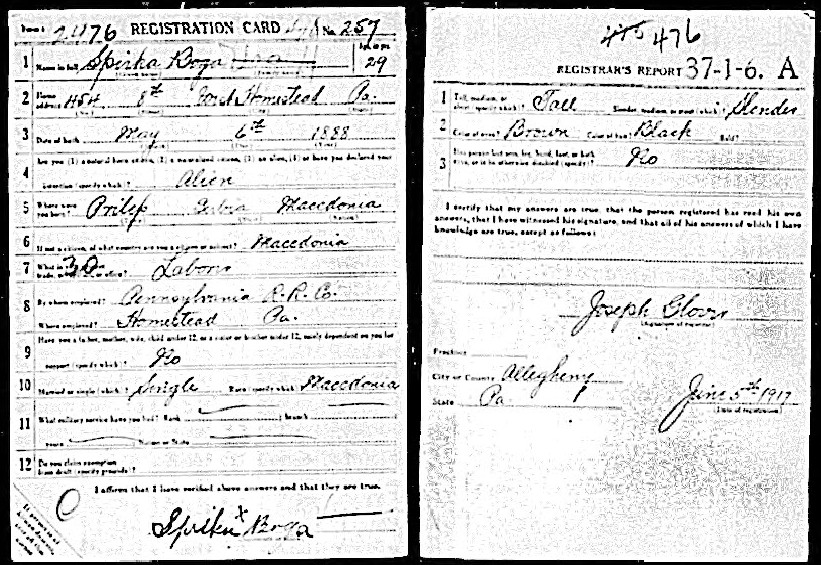
Macedonians drafted into the US Army, World War I, 1917


Here are 10 World War I draft registration cards from the United States Army. Please notice whom they drafted, Macedonians from Macedonia that were living in USA.
Pay extra attention to the below noticed paragraphs:

#5 Where were you born?
#6 If not a citizen, of what country are you a citizen or subject?
#10 Race (specify which)?


Dimitar Rizov speaks about his Macedonian nationality, 1912

1912
Bulgarian statesman Dimitar Rizov on his nationality
…In the golden months of the successful beginning of the war against the Turks, he spoke to me as a convinced Yugoslav (South Slav). He explained to me, I being a Croat, the real situation of matters in Macedonia and said that it was shame that the first free Slav state had not been founded in Macedonia, which would equally attract to union the Bulgarians and the Serbs, and would be a bond and not a cause of discord between the Serbs and the Bulgarians…He told me that the Macedonians, to tell the objective truth, were neither Bulgarians nor Serbs, but Macedonian Slavs who spoke in their own individual Macedonian language or dialect. …”Our people”, he said, “were only ‘Macedonian Christians,’ and then, when Greek propaganda developed they become ‘Macedonian Christian Slavs’. It was all the same to us which Christian country would help us to free ourselves from the Turks. I was born in Bitola. There were several grammar-schools in Bitola: Turkish, Greek, Serbian and Bulgarian. It was all the same to us, the Slavs, which Slav grammar-school we attended. For example, alongside many of my friends who later became Bulgarians, I attended the Serbian grammar-school. It is true that the teachers in the grammar-school told we were Serbs, just as those in the Bulgarian grammar-school were told that we were Bulgarians, but we kept our own counsel, and that was what our parents told us at home: it does not matter, let them talk, but we are Macedonian Christian Slavs…”
Taken from Ivan Meshtrovic, famous Croatian sculptor, Uspomene na politichke ljude i dogagjaje. Zagreb 1969, pages 25-26 and 39.

Memorandum on the Independence of Macedonia, 1913

March 1, 1913
Memorandum on the Independence of Macedonia submitted by the Macedonian colony in St. Petersburg to the Conference of the representatives of the Great Powers in London.
…it is more suitable for all the neighbors of Macedonia that this country remain undivided, since by any division, sections of our living compatriots will remain under foreign authority and will perish. The Macedonians have won their right to self-determination over their whole recent history, as well…
The Serbs and the Bulgarians deliberately say nothing about these huge Macedonian victories and permit nobody to write about them…
As a result of all this, the Macedonian Colony in St.Petersburg, fulfilling its sacred duty towards its fatherland and conscientiously applying the slogan “Macedonia to the Macedonians”, protests and cannot remain indifferent when the allied Balkan states (Bulgaria, Serbia and Greece) – our brothers in blood and faith – aim to dismember our fatherland….
Here is what is needed for the Macedonian people;
1. Macedonia should remain a single, indivisible and independent Balkan state with it geographic, ethnographic, historical, economic and political borders.
2. A Macedonian national assembly should be established on the basis of general elections in Salonika in the soonest possible time, which would work out in detail the internal structure of the state and determine its relations with the neighboring states.
Taken from Makedonskii Golos, St. Petersburg 1913-1914.